
The Great Rejection: It's Not Laziness, It's Biology
Let's address the elephant in the room immediately. You are not broken. You are not lazy. And you certainly aren't lacking in moral fiber because you'd rather reorganize your entire spice rack alphabetically than answer that one email that has been sitting in your inbox since Tuesday. What you are experiencing is a biological revolt. Your brain is looking at a mundane, low-stimulation task and reacting with the same visceral horror your immune system might display if you tried to swap out a kidney for a toaster.
This isn't a character flaw; it is a feature of your hardware. For many of us, particularly those navigating neurodivergence, the brain doesn't just prefer novelty — it demands it. When we encounter tasks that lack immediate reward, clear structure, or inherent interest, our neural pathways don't just slow down; they actively shut the door. We need to stop viewing this resistance as a failure of willpower and start seeing it for what it truly is: a mismatch between your brain's operating system and the software you're trying to run.
The Dopamine Drought: Starving the Engine
To understand why boredom feels physically painful, we have to look under the hood at dopamine. Most people think of dopamine as the "pleasure chemical," but that's a simplification that does it a disservice. Dopamine is actually the molecule of more. It is the fuel for motivation, the spark that ignites action, and the bridge between knowing what to do and actually doing it. In a neurotypical brain, this fuel is distributed relatively evenly, allowing for steady engagement with mundane tasks.
However, in brains wired differently, such as those with ADHD, the dopamine supply chain is notoriously unreliable. It's less like a steady drip-feed and more like a fire hose that only turns on when there is a crisis, a deadline, or something genuinely fascinating. When you face a boring task, your brain isn't just uninterested; it is literally starving for the chemical currency required to initiate movement. Without that surge, the engine sputters. You aren't refusing to work; you are waiting for fuel that isn't coming. This is why "just try harder" is biologically nonsensical advice. You cannot white-knuckle your way out of a neurochemical drought.
Executive Function: The Overworked Air Traffic Controller
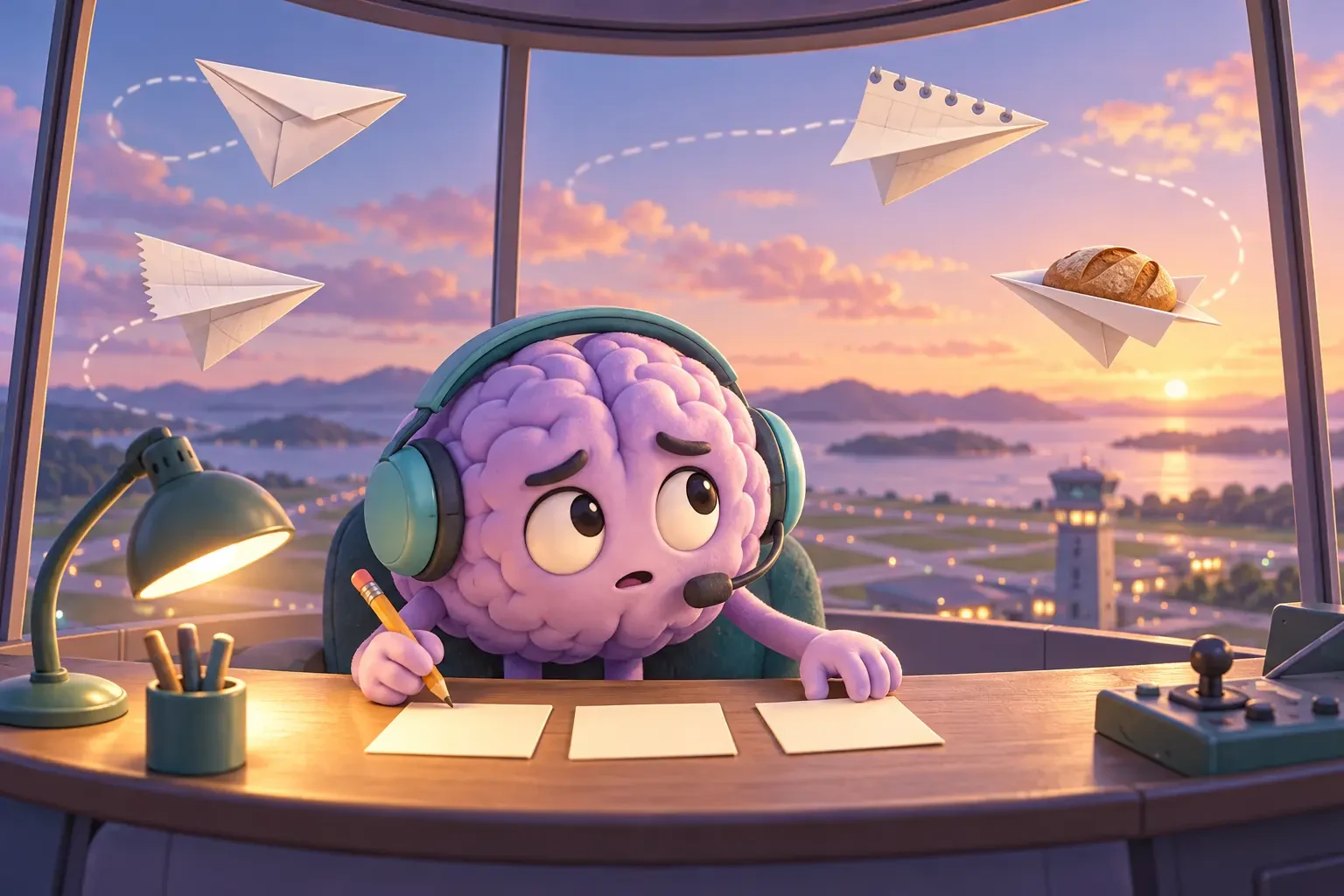
If dopamine is the fuel, then executive function is the air traffic controller managing the runway. This complex set of mental skills helps us plan, focus attention, remember instructions, and juggle multiple tasks successfully. For many, this controller is efficient, calm, and organized. But for others, the control tower is understaffed, the radar is glitchy, and every plane is screaming for landing clearance at the same time.
When a task is boring, it offers no external structure to help the air traffic controller do its job. There is no urgency to prioritize the flight, no novelty to grab its attention. Consequently, the controller gets distracted by a shinier, louder plane — like suddenly remembering you need to research the history of sourdough bread starters. This isn't defiance. It is a system overload. The brain seeks stimulation to keep the controller awake and engaged. Without that stimulation, the entire airport grinds to a halt, leaving you staring at a blank document while your internal monologue critiques your life choices.
The Neuroscience of "Underload": Why Quiet is Loud
Here is where things get counterintuitive. We often assume that boredom is a state of low activity. However, neuroscience tells us that for the restless mind, boredom is actually a state of high-intensity discomfort. When the external world fails to provide enough stimulation, the brain turns inward. It starts scanning for threats, regrets, and hypothetical disasters. This is why sitting still to do taxes can feel more exhausting than running a marathon.
Your brain is essentially idling at 8,000 RPMs while parked in neutral. This state of "underload" creates a feedback loop of anxiety and restlessness. The brain perceives the lack of input as a threat to its equilibrium. It begins to generate its own noise to fill the void. This is why you might feel an urgent need to clean the baseboards or check your phone for the tenth time in a minute. You are not avoiding the work; you are desperately trying to regulate your nervous system by finding any source of engagement, no matter how trivial. The boredom isn't empty; it's noisy, chaotic, and demanding.
The Interest-Based Nervous System: Following the Spark

Traditional productivity advice assumes we all operate on an importance-based nervous system. If a task is important, we should do it. But for many creative and neurodivergent minds, we operate on an interest-based nervous system. We don't move toward what is important; we move toward what is interesting, challenging, novel, or urgent. This isn't a bug; it's a different architectural design.
A motorboat can go in any direction as long as you have fuel. A sailboat needs wind. You can't force the wind to blow by yelling at the sails.
Think of it like a sailboat versus a motorboat. A motorboat (importance-based) can go in any direction as long as you have fuel. A sailboat (interest-based) needs wind. You can't force the wind to blow by yelling at the sails. You have to wait for it, or you have to tack creatively to catch the breezes that are already there. When you try to force yourself to do a boring task, you are trying to sail in a dead calm. It's frustrating, it's slow, and it often leads to capsizing. Instead of fighting the lack of wind, we need to learn how to build our own gusts. We need to engineer interest into the mundane.
Gamification: Hacking the Reward Loop
So, how do we build our own wind? We hack the system. This is where the "polymath therapist" mindset comes into play. We stop treating tasks as chores and start treating them as games. Gamification isn't just for apps; it's a survival strategy for the executive function-challenged brain. By adding elements of play, competition, or narrative, we artificially inject the dopamine our brains are craving.
These aren't childish tricks; they are strategic interventions. They bypass the brain's resistance to boredom by attaching a layer of novelty and immediate reward to the task. You are tricking your air traffic controller into paying attention by making the plane look shiny and dangerous.
Body Doubling: The Social Scaffold

Sometimes, internal hacks aren't enough. Sometimes, you need an external anchor. This is where body doubling comes in. Body doubling is the practice of working alongside someone else, even if they aren't helping you with the task. Their presence provides a subtle social pressure and a sense of shared reality that can ground the wandering mind. It's not about accountability in the punitive sense; it's about co-regulation.
When another person is present, our mirror neurons fire. We unconsciously mimic their focus and calm. It creates a container for our attention. If you struggle to start a task, invite a friend to sit with you while you both work on your respective projects. Or, join a virtual co-working space. The key is that the other person doesn't need to manage you; they just need to exist near you. This simple act of shared presence can lower the activation energy required to start. It transforms the lonely, daunting task into a shared human experience, making the boredom feel less isolating and more manageable.
Designing Your Architecture: From Insight to Action
Ultimately, resilience isn't about forcing yourself to endure boredom until you break. It's about designing an environment and a lifestyle that respects your brain's unique architecture. We need to move away from the idea that there is one "right" way to work. The standard 9-to-5, open-office, linear-task model was built for a specific type of brain, and it fails millions of others.
Start experimenting. Notice when your brain rejects a task. Don't judge it; get curious. Ask yourself: Is this a dopamine issue? Do I need to gamify this? Is this an executive function overload? Do I need to break this down into microscopic steps? Is this a regulation issue? Do I need to move my body or have a body double? Build your own toolkit. Create your own systems. Stop trying to fit your square-peg brain into a round-hole world. Instead, build a new hole. One that fits. One that allows you to thrive, not just survive. Because emotional growth and professional success are not magic. They are architecture. And you are the architect.
This post is for educational and psychoeducational purposes and isn't a substitute for individualized mental health treatment, crisis support, or professional consultation. If you're in crisis, please reach out to a trusted professional or a crisis support line right away.